
The Enigmatic Merlin
Tracing the Wizard’s Journey from Welsh Legend to Arthurian Icon
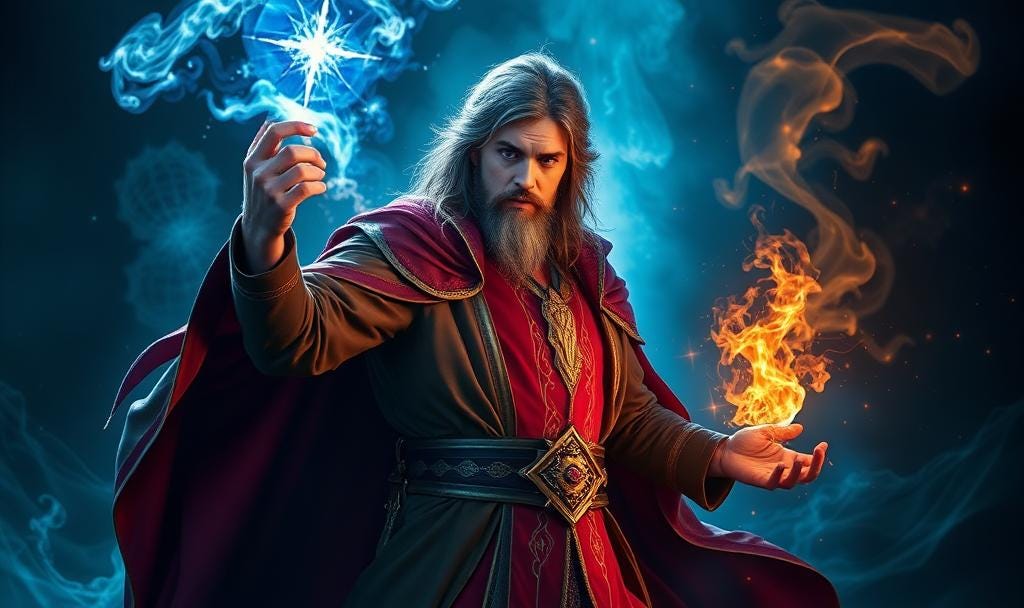
The Enigmatic Merlin: Tracing the Wizard’s Journey from Welsh Legend to Arthurian Icon
The figure of Merlin stands as one of the most enduring and captivating characters in Western mythology. Part prophet, part wild man, part royal counsellor, this shape-shifting wizard has captured imaginations for over a millennium. But who was Merlin, really? And how did a Welsh bard and madman transform into the white-bearded sage guiding King Arthur through the perils of Camelot?
The Welsh Roots: Myrddin and the Mabinogion
Before Merlin became Arthur’s mentor, he existed in Welsh tradition as Myrddin Wyllt (Myrddin the Wild). This figure was a bard and prophet who, according to legend, went mad after witnessing the horrors of the Battle of Arfderydd in 573 CE. Driven insane by grief and guilt, Myrddin fled to the Caledonian Forest, where he lived among the trees and animals, gaining prophetic powers through his communion with nature.
The Welsh literary tradition preserved in the Mabinogion, a collection of medieval Welsh tales compiled from earlier oral tradition, contains threads that would eventually weave into the Merlin tapestry. While Myrddin doesn’t appear directly in the core tales of the Mabinogion, the collection established the mythic landscape that made his later emergence possible. The Mabinogion’s tales of magic, transformation, and the interplay between the mortal and supernatural worlds created the cultural soil from which Merlin would grow.
The figure of Taliesin, the legendary bard who appears in later Mabinogion-related texts, shares fascinating parallels with Merlin. Both possessed prophetic knowledge, both moved between worlds, and both served as bridges between ancient Celtic wisdom and the courts of kings. Taliesin’s miraculous birth and transformation from the boy Gwion Bach echoes the supernatural origins that would later be attributed to Merlin.
Geoffrey of Monmouth: The Architect of Merlin’s Transformation
The true transformation of Myrddin into Merlin occurred in the 12th century through the work of Geoffrey of Monmouth, a Welsh cleric writing in Latin. In his “Historia Regum Britanniae” (History of the Kings of Britain, circa 1136), Geoffrey latinized Myrddin to “Merlinus”—supposedly to avoid unfortunate associations with the French word “merde.”
Geoffrey’s Merlin was a spectacular reimagining. He gave the wizard a dramatic origin story: Merlin was born to a mortal woman and an incubus, a demon who visited her in the night. This diabolical parentage explained Merlin’s supernatural powers while his mother’s purity and his Christian baptism ensured he used those powers for good rather than evil. It was a brilliant narrative solution that made Merlin both powerful and palatable to medieval Christian audiences.
In Geoffrey’s account, Merlin engineered the conception of Arthur through magic, disguising Uther Pendragon as the Duke of Cornwall to sleep with the duke’s wife, Igraine. He also transported the massive stones of Stonehenge from Ireland to Salisbury Plain—a tale that connected ancient megalithic mysteries to Arthurian legend.
The Matter of Britain: Merlin Meets Arthur
As Arthurian literature flourished across medieval Europe, Merlin’s role expanded and evolved. French poet Robert de Boron’s “Merlin” (circa 1200) elaborated on Geoffrey’s foundation, adding the iconic image of the sword in the stone and deepening Merlin’s role as Arthur’s mentor and the architect of the Round Table.
The connection between the Welsh magical traditions and the Arthurian cycle represents a fascinating cultural synthesis. The Celtic otherworld, with its shape-shifters, enchantments, and questing heroes from the Mabinogion and related Welsh tales, merged with Continental romance traditions to create something entirely new. Merlin became the lynchpin of this fusion—a character who could explain the magical elements while also serving as counselor and prophet.
In Thomas Malory’s “Le Morte d’Arthur” (1485), Merlin reaches perhaps his most developed medieval form. He guides Arthur from birth, ensures he claims his kingship, advises him in matters of state and war, and warns him of future dangers. Yet even Malory’s Merlin cannot escape fate: the wizard falls victim to his own passion for the Lady of the Lake (called Nimue or Viviane in various versions), who traps him in a cave or tower using his own magic against him.
The Paradox of the Prophet
One of Merlin’s most compelling characteristics is his prophetic knowledge coupled with his inability to change certain outcomes. He knows he will be entrapped by Nimue, yet cannot prevent it. He foresees Arthur’s kingdom will fall, yet works tirelessly to build it. This tragic awareness makes Merlin deeply human despite his supernatural origins—he embodies the universal experience of seeing disaster approach without being able to alter its course.
This prophetic tradition connects directly back to Myrddin’s Welsh roots. The historical Myrddin was said to have prophesied the future of Britain, the conflicts between the Welsh and Saxon invaders, and the eventual return of Celtic sovereignty. These prophecies, deeply political in nature, were preserved in medieval Welsh poetry and later appropriated by Geoffrey of Monmouth for his own historical and political purposes.
From Mabinogion Magic to Arthurian Majesty
The journey from the Mabinogion’s enchanted world to the Arthurian court represents more than just literary evolution—it reflects profound cultural changes in medieval Britain. The wild, untamed magic of Celtic tradition, where druids and bards held power and the boundaries between human and animal, natural and supernatural were fluid, gradually transformed into the more ordered, Christian-inflected magic of the Arthurian romances.
Yet Merlin never entirely lost his wildness. Even in his most courtly appearances, there’s something untamed about him—his prophetic trances, his mysterious disappearances, his shape-shifting abilities, and ultimately his withdrawal from human society altogether. He remains a liminal figure, never quite domesticated by the court he serves.
The Mabinogion’s influence on Arthurian legend extends beyond Merlin. The tale of “Culhwch and Olwen” presents an early Arthur surrounded by heroes with magical abilities, hunting supernatural beasts. The enchantments and quests of these Welsh tales established patterns that would be refined and elaborated in later Continental romances. Merlin became the character who could bridge these traditions, explaining and facilitating the magic that made Arthur’s world wondrous.
Merlin’s Modern Metamorphosis
Today, Merlin continues to transform. Modern retellings have reimagined him in countless ways: as a time-traveler living backward through history (T.H. White’s “The Once and Future King”), as a woman (various feminist retellings), as a mentor figure in fantasy literature from Tolkien’s Gandalf to Dumbledore, and as everything from a historical druid to an alien visitor.
This adaptability is perhaps Merlin’s greatest magic. Like the shape-shifter of Celtic tradition, he assumes whatever form the age requires. Yet beneath each transformation, we can still trace the lineage back through the medieval romances, through Geoffrey of Monmouth’s Latinized history, to the mad prophet in the Caledonian Forest, and ultimately to the deep well of Welsh mythology preserved in the Mabinogion and related texts.
The Enduring Enchantment
Merlin endures because he represents something fundamental about wisdom and power. He is the advisor who shapes events from behind the throne, the prophet cursed with knowledge of catastrophes he cannot prevent, the wild man who understands nature’s secrets, and the teacher whose most extraordinary magic is inspiring greatness in others.
His journey from Myrddin to Merlin, from the forests of Wales to the courts of Camelot, from the Mabinogion’s magical landscape to the heart of Arthurian legend, mirrors the broader evolution of British mythology itself. In his character, pagan and Christian, Celtic and Continental, ancient and medieval traditions merge into something timeless.
Perhaps that’s the final enchantment: Merlin makes us believe that wisdom and magic might still exist, just beyond the edge of the forest, waiting to guide those worthy enough to seek it. And in every generation, we continue to seek—not just Arthur, but his wizard too.
Alan /|\
Thanks for this. It reminded me again of the hope we all carry, in the face of disaster. How we struggle to keep hope alive in the face of impossible odds. It feels a timely reminder, somehow.